 Zerolend
 borrowing tied debt settlement and collateral withdrawal to different conditions.
Zerolend borrowing created collateral-backed debt whose repayment reduced the obligation without automatically returning pledged assets to a wallet. The team announced a wind-down on February 16, 2026, and urged users to withdraw remaining funds. Existing positions therefore needed separate attention to debt settlement, collateral eligibility, and market liquidity. A loan balance could continue accruing interest, while a withdrawal faced its own account-health and reserve constraints.
In short: Accrued interest could leave debt outstanding after a principal-only repayment, keeping pledged collateral subject to the remaining position’s health requirements.
Collateral-backed loans and delegated borrowing
Self-collateralized borrowing used an account’s eligible deposits to access pooled liquidity, while delegated borrowing used credit that another depositor explicitly authorized. Ordinary loans let depositors retain exposure to their pledged assets while receiving a supported loan asset. The market’s collateral requirements governed the obligation, and withdrawing those deposits could affect the position’s health.
Credit delegation assigned different roles to the participants. A depositor authorized another user to access borrowing power, with debt recorded against the delegator’s account. The receiving wallet and the account that owed the debt could therefore differ. Delegated borrowing still depended on the delegator’s collateral capacity and the market’s restrictions.
Capacity within the selected market
Available capacity reflected eligible collateral and existing debt, while reserve restrictions could prevent a loan even when the collateral remained sufficient for the requested borrowing.
Collateral eligibility
Supplied assets counted toward ordinary borrowing power only when the market accepted them as collateral and the account enabled that use. The loan-to-value (LTV) limit constrained debt relative to eligible collateral value. An asset’s historical category, including a stablecoin or liquid restaking token grouping, did not set its individual collateral parameters. The selected market and wallet network also had to match; a balance elsewhere did not constitute collateral in that pool.
Restrictions on the requested loan
Reserve status and caps
The Aave V3-based core required an active, unpaused, unfrozen reserve with borrowing enabled. It also enforced any configured borrow cap across that reserve’s total debt. Pool liquidity concerned another constraint: the reserve needed enough of the selected asset to deliver the loan.
Category and isolation restrictions
An active efficiency mode category restricted borrowed assets to that category in the documented core. Isolation rules restricted permitted debt assets and enforced each isolated collateral asset’s aggregate debt ceiling across the market. Those settings governed the transaction independently of a token’s broad asset classification.
When did a borrowing request become a debt?
A borrowing request became a debt when the market successfully executed the loan and recorded the obligation against the liable account. The historical Linea ETH borrowing flow separated collateral eligibility from transaction completion.
- Eligible deposits needed collateral use enabled in the Linea market, with sufficient unused borrowing capacity for the requested amount.
- The ETH or WETH choice, requested amount, and borrowing terms defined the loan that the wallet authorized.
- A request that would exceed a configured cap on total reserve debt or the account’s collateral capacity failed validation without adding the requested debt.
- A smaller request could address an amount limit, but it could not bypass a frozen reserve or restore missing liquidity.
- Successful execution paired receipt of the selected loan asset with the corresponding debt entry against the liable account on that network.
Submission alone did not establish a completed loan. Borrowing cost followed the debt amount, accrual time, and applicable rate. These historical completion conditions did not establish that the Linea loan flow remained open during the wind-down.
Interest costs and the remaining debt
Accrued interest increased the amount owed, so an original loan amount could understate the later payment required to close that debt. For variable-rate loans, changing pool utilization could change the applicable rate before settlement. The dashboard’s debt figure and supply balance described different sides of the position. Rewards or points belonged to a separate incentive calculation; their displayed value did not establish payment of borrowing interest.
Collateral values and liquidation exposure
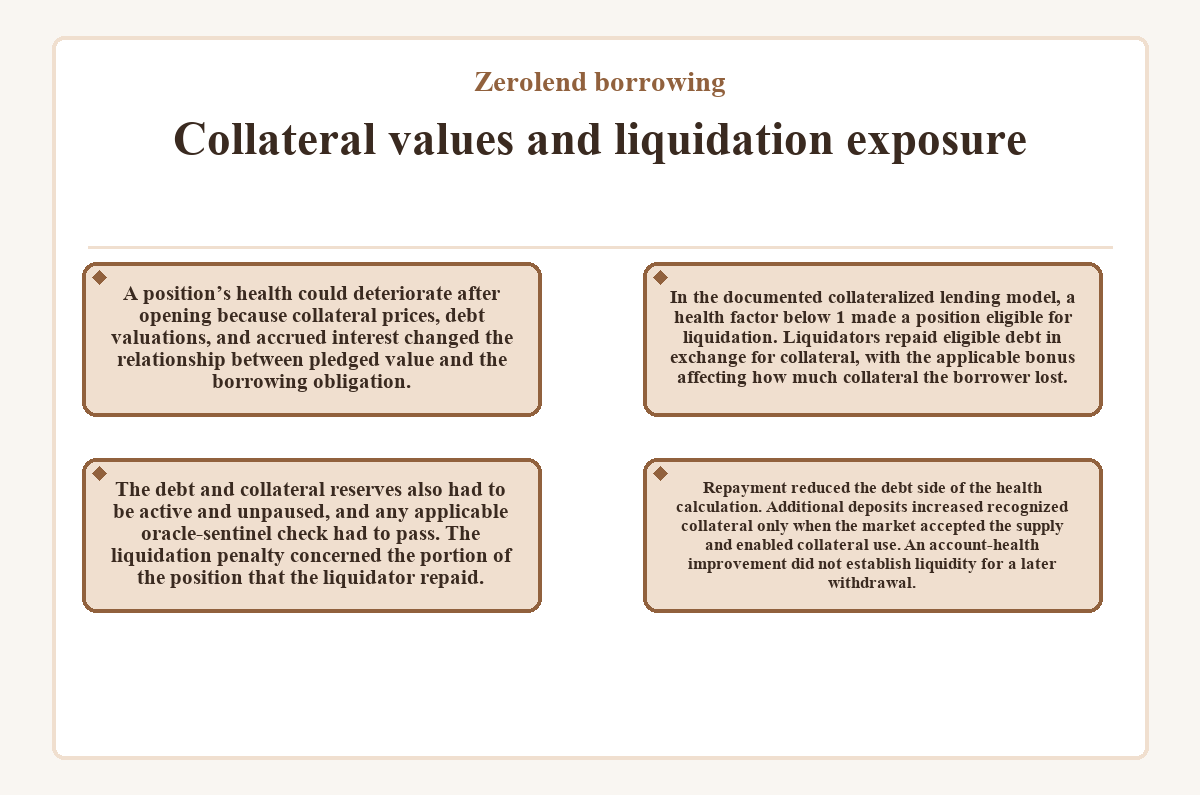
A position’s health could deteriorate after opening because collateral prices, debt valuations, and accrued interest changed the relationship between pledged value and the borrowing obligation. In the documented collateralized lending model, a health factor below 1 made a position eligible for liquidation. Liquidators repaid eligible debt in exchange for collateral, with the applicable bonus affecting how much collateral the borrower lost. The debt and collateral reserves also had to be active and unpaused, and any applicable oracle-sentinel check had to pass. The liquidation penalty concerned the portion of the position that the liquidator repaid.
Repayment reduced the debt side of the health calculation. Additional deposits increased recognized collateral only when the market accepted the supply and enabled collateral use. An account-health improvement did not establish liquidity for a later withdrawal.
Repayment methods and the remaining balance
The documented Aave V3-based core allowed partial or full repayment of debt in a selected asset and interest rate mode. An ordinary wallet-funded repayment reduced recorded debt by transferring the matching underlying asset into its reserve. Token authorization allowed the contract to spend the required asset; authorization alone did not reduce the loan. Its repayment checks required an active, unpaused reserve.
The core exposed another method using matching supply tokens from the same reserve. That method reduced both the supplied balance and the borrower’s own debt, without first transferring underlying assets back to a wallet. Availability for a remaining position depended on its deployed contracts and the interface’s supported repayment methods.
Partial repayment left a balance that could continue accruing interest under its rate model. Full settlement concerned the accrued obligation, including residual amounts after interest updates. A principal-only payment could leave debt outstanding even after a transaction succeeded.
Does repaying a loan complete a collateral exit?
Repaying a loan did not by itself complete a collateral exit, because withdrawal also depended on reserve liquidity and any remaining collateral obligations. In the Aave V3-based withdrawal logic, removing pledged collateral while debt remained triggered a health check. Clearing one loan could leave another obligation within the same market.
The wind-down plan also addressed assets stuck on networks with impaired liquidity and proposed contract upgrades to redistribute them. An announced upgrade did not prove a completed redistribution. A successful withdrawal transferred underlying assets to its chosen recipient and reduced the corresponding supply claim.
Keeping a partially repaid loan open retained exposure to interest and collateral-price changes. Settling it fully removed that borrowing exposure, while an unreleased supply balance remained subject to liquidity and the applicable wind-down process.
Worth knowing
Did an ETH balance prove that a WETH borrowing obligation had been settled?
An ETH wallet balance did not prove settlement of a WETH-denominated borrowing obligation. The historical Linea borrowing flow included ETH and WETH choices, but repayment still needed to address the matching debt reserve.
Could someone else repay a Zerolend debt?
The documented Aave V3-based core allowed repayment of a specified amount on behalf of another account. The payment needed the debt asset and corresponding interest rate mode, and reserve-state restrictions still applied. The paying address could differ from the address whose obligation decreased. This payment did not transfer ownership of the collateral or make the payer the owner of the borrowing position.
Was a frozen reserve the same as a paused reserve for repayment?
A freeze and a pause affected repayment differently in the documented Aave V3-based core. Borrow validation rejected frozen reserves, while repayment required an active, unpaused reserve without rejecting its frozen flag. A freeze alone therefore did not imply blocked repayment. Repayment still depended on the actual reserve state and the supported payment method.
What happened to a repayment request that exceeded the debt owed?
The documented core capped the amount consumed at the debt owed in the selected asset and interest rate mode. A larger requested amount did not create additional repayment credit. Ordinary wallet-funded repayment transferred that capped amount into the reserve. Other assets or another debt type could still leave an obligation on the account, even after the selected debt reached zero.
Would holding ZERO tokens count as repaying a borrowing position?
Holding ZERO did not itself repay a borrowing position. ZERO belonged to the governance and incentive system, while a lending obligation remained denominated in its borrowed asset. A reward allocation or token balance did not record a payment into the matching debt reserve.
Were interest rate modes interchangeable when closing a loan?
The documented core associated each repayment with a specific debt asset and interest rate mode. Where an account held stable-rate and variable-rate debt in the same reserve, clearing one type could leave the other outstanding. Those accounting modes did not establish that every market offered both choices. A complete settlement concerned all outstanding obligations in the relevant position.
Can a variable debt token be transferred to move a Zerolend loan?
The documented variable debt token disabled ordinary token transfers, so transferring it could not move an existing loan. Credit delegation handled borrowing authority through a separate approval mechanism, with debt assigned to the delegator’s account. It did not make the existing debt token transferable or remove the collateral owner’s exposure.
Updated