 Zerolend
 Lending Markets, Collateral, and the Wind-Down
Zerolend operated a multichain lending protocol whose team announced a wind-down and urged users to withdraw remaining funds. Its core business connected liquidity suppliers with borrowers who pledged collateral worth more than their loans. Liquid restaking tokens and tokenized real-world assets extended the assets that its lending markets could serve. ZERO belonged to the governance and incentive system. The team’s February 16, 2026 announcement changed the context for these products: historical descriptions explain how the platform worked, while existing balances raise questions about withdrawals and debt. A closure announcement does not establish that every depositor has received their assets.
Jump to a section
Lending pools and collateral roles
Liquidity pools supplied the assets that borrowers accessed, while collateral secured the obligations that those borrowers created. Smart contracts managed these relationships within the protocol’s non-custodial lending model. Users interacted with a market through their wallets, and the market’s rules governed the resulting positions.
Supplying and borrowing had different purposes. A supplier placed eligible assets into a lending market to earn its applicable supply return. A borrower obtained supported assets against collateral, accepting borrowing costs and liquidation exposure. Some users did both, so a supplied balance could also help secure a loan. Withdrawing that collateral and repaying the loan affected different sides of the position.
Price feeds and the liquidity behind each market
Price feeds supplied asset valuations for collateral checks and liquidation decisions. Pool liquidity concerned the assets available within the lending market.
Borrowing capacity depended on collateral and the market’s risk parameters. The liquidation threshold addressed a separate boundary where debt became unsafe relative to collateral. Interest and price changes could alter that relationship after a loan originated.
What led to the February 2026 wind-down?
The team announced the wind-down on February 16, 2026 because it considered the lending business unsustainable in its existing form.
Several supported chains had become less active or less liquid. That reduced the activity available to sustain lending markets and revenue. The team also described some oracle providers discontinuing support, which made reliable market operation harder.
Security demands added pressure. The announcement described increased attention from hackers and scammers as the protocol grew. Thin lending margins left less room to absorb that burden, and the team reported prolonged periods of losses.
The combined pressures led to a closure plan and a request to withdraw remaining funds. This decision concerned the lending business as a whole. Older product descriptions consequently explain its historical functions without establishing a continuing commitment to originate loans.
Remaining deposits and withdrawal constraints
The team urged users with remaining funds to withdraw them as part of the wind-down. That request established the intended direction of closure, without confirming the outcome for each position.
Collateral secured outstanding debt under the lending model. Taking collateral out reduced the value supporting that debt, while repayment reduced the obligation. A general withdrawal request therefore did not make a borrowing position equivalent to a deposit with no debt. Closure itself also did not constitute repayment of an existing loan.
In its February 2026 statement, the team said some funds might be stuck on chains with deteriorated liquidity and planned contract upgrades to redistribute them.
Liquid restaking tokens as collateral
LRT lending let holders use supported liquid restaking tokens as collateral for loans in stablecoins or ETH. The purpose was access to liquidity while retaining exposure through the deposited token.
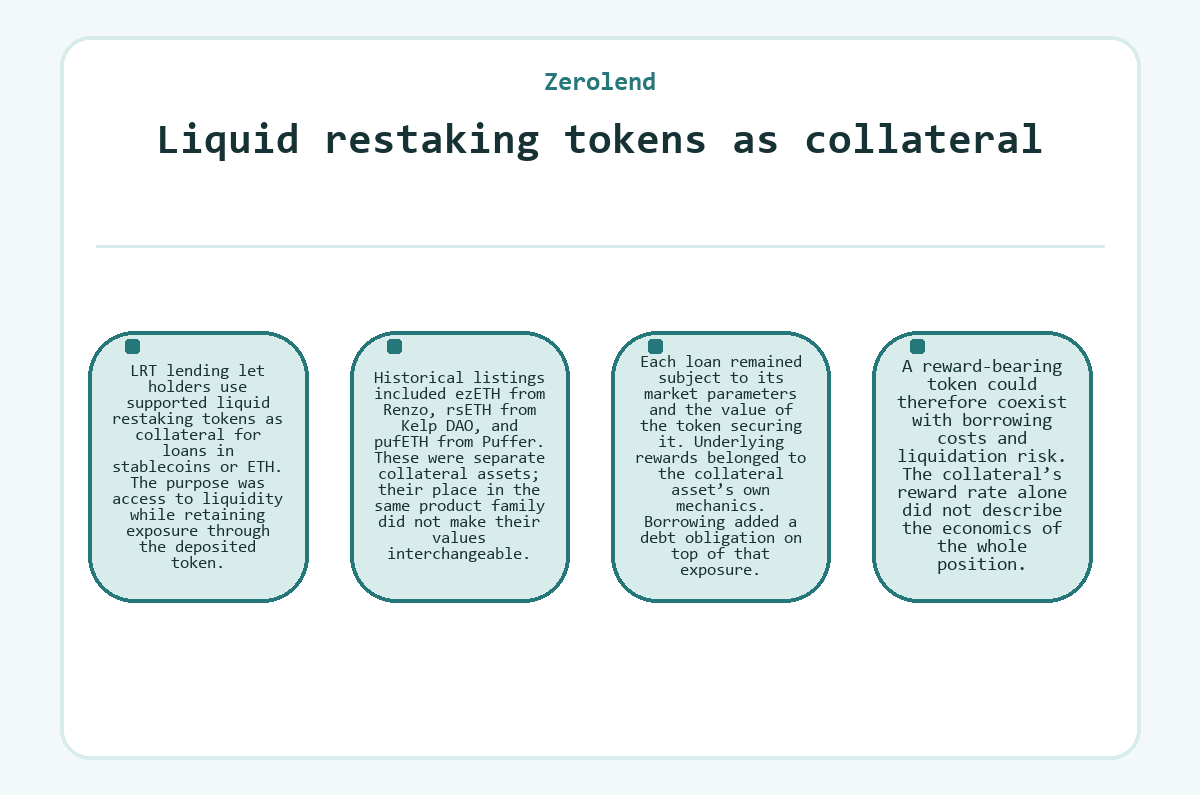
Historical listings included ezETH from Renzo, rsETH from Kelp DAO, and pufETH from Puffer. These were separate collateral assets; their place in the same product family did not make their values interchangeable. Each loan remained subject to its market parameters and the value of the token securing it.
Underlying rewards belonged to the collateral asset’s own mechanics. Borrowing added a debt obligation on top of that exposure. A reward-bearing token could therefore coexist with borrowing costs and liquidation risk. The collateral’s reward rate alone did not describe the economics of the whole position.
Real-world assets within the lending model
RWA lending used tokenized real-world assets as collateral for overcollateralized loans in stablecoins or ETH. This expanded the collateral model beyond purely crypto-native assets. The tokenized asset retained its own economic exposure, while the lending market supplied credit against its accepted value. A connection to a real-world asset did not establish unrestricted borrowing capacity or immediate withdrawal liquidity. The closure context applied to this product family alongside the protocol’s other lending markets.
Bitcoin finance and meme-coin exposure
BTCFi and meme coins also formed part of the platform’s documented scope. BTCFi markets supported supplying and collateralized borrowing of Bitcoin-linked tokens such as cbBTC and WBTC, while meme coins introduced a different type of asset exposure.
The shared lending structure did not make all these assets equivalent. The asset, the market that listed it, and its applicable parameters determined a position’s terms. A broad product category described the platform’s focus without establishing that every token in that category qualified as collateral. The team’s February 2026 statement also described efforts to trace and recover funds after a February 2025 exploit of a Bitcoin product on Base. It promised affected suppliers a partial refund funded from an airdrop allocation that the team had received.
ZERO governance and historic incentives
ZERO was the token assigned to governance of the Zerolend protocol. The historical ecosystem also used the token in its incentive design.
Supply and borrowing programs could add incentives alongside a lending position. Some programs used ecosystem or partner points, while token incentives involved separate rewards. Their terms belonged to the particular program, rather than to every deposit indefinitely.
Staking material described locking ZERO for a defined duration in exchange for vote-escrowed tokens. That commitment differed from supplying an asset as lending collateral. A staking lock and a collateral position therefore needed their own terms and balance interpretation.
Emissions schedules and claim windows belonged to individual programs. Historical descriptions of rewards supplied no continuing payment schedule for the wind-down.
A ZERO reward payout and an unconfirmed withdrawal
A ZERO reward payment would confirm an incentive payout, while the return of supplied capital concerns a separate lending balance.
In this hypothetical example, a saved account view shows a supplied asset and a separate ZERO reward balance. A later record shows only a completed ZERO reward payout to that wallet. The supplied asset represents the lending position, while the ZERO entry represents an incentive associated with ecosystem participation.
The reward has been paid in this example, and the record leaves the deposit’s return unconfirmed.
Can audits establish that funds remain withdrawable?
Audits cannot establish that every market retains enough liquidity for withdrawals. They assess particular code and security assumptions within their scope. The core lending system originated as an Aave V3 fork, and the project published additional external audit material.
Administrative controls addressed another part of the system. The documented design used a multisignature authority and delayed execution for administrative changes. Those controls concerned who could authorize changes and when; they did not constitute an individual depositor’s withdrawal confirmation.
Security review and administrative protections could address specific risks while the lending business still depended on functioning markets. A completed code audit supplied no assurance that an oracle provider would keep serving a particular deployment or that usable liquidity would remain available there.
Zerolend questions, answered
What did supply APY and borrow APY measure?
Supply APY described an annualized return on supplied assets, while borrow APY described an annualized borrowing cost. Rates responded to market conditions, so an old displayed percentage was not a fixed promise for an entire holding period. Ecosystem points and token incentives also had their own program terms.
Could the same wallet have lending positions on different networks?
A wallet could interact with more than one of the platform’s historical lending markets. Those markets included deployments on Ethereum and Linea, so each balance needed its network and market context. An entry for one deployment did not describe all of that wallet address’s positions across the protocol.
Did the administrative timelock set a withdrawal payment deadline?
The administrative timelock concerned delayed execution of authorized protocol changes, rather than a promised date for a depositor’s payout. Its waiting period applied to an administrative proposal becoming executable. It did not measure an individual withdrawal’s duration or establish that the market held enough liquidity to satisfy it.
Does a published app mean that new loans remain available?
A publicly accessible application does not by itself establish that new borrowing remains available. A static front end can continue to describe historical functions during a wind-down. The February 2026 decision concerned the operating protocol, so old borrowing screens cannot establish available lending capacity for a particular market.
Were the original collateral limits identical for every asset?
Different collateral assets had different loan-to-value limits within the documented lending model. Max LTV expressed how much borrowing a collateral value could support, while the liquidation threshold addressed a separate risk boundary. A percentage quoted for one asset and market did not define the limit for every other position.
Updated